

2026
Employee Management
5 minutes read

From time tracking to compliance: how to prepare your organization for 2026

Written by: Ray Fitusi
  • As 2026 unfolds, a series of challenges are already taking shape in the global labor market. Companies must navigate a landscape defined by evolving security concerns, economic uncertainty, increasingly strict regulations, and rising employee expectations. Here are some of the key challenges organizations should be aware of to prepare effectively for the year ahead:
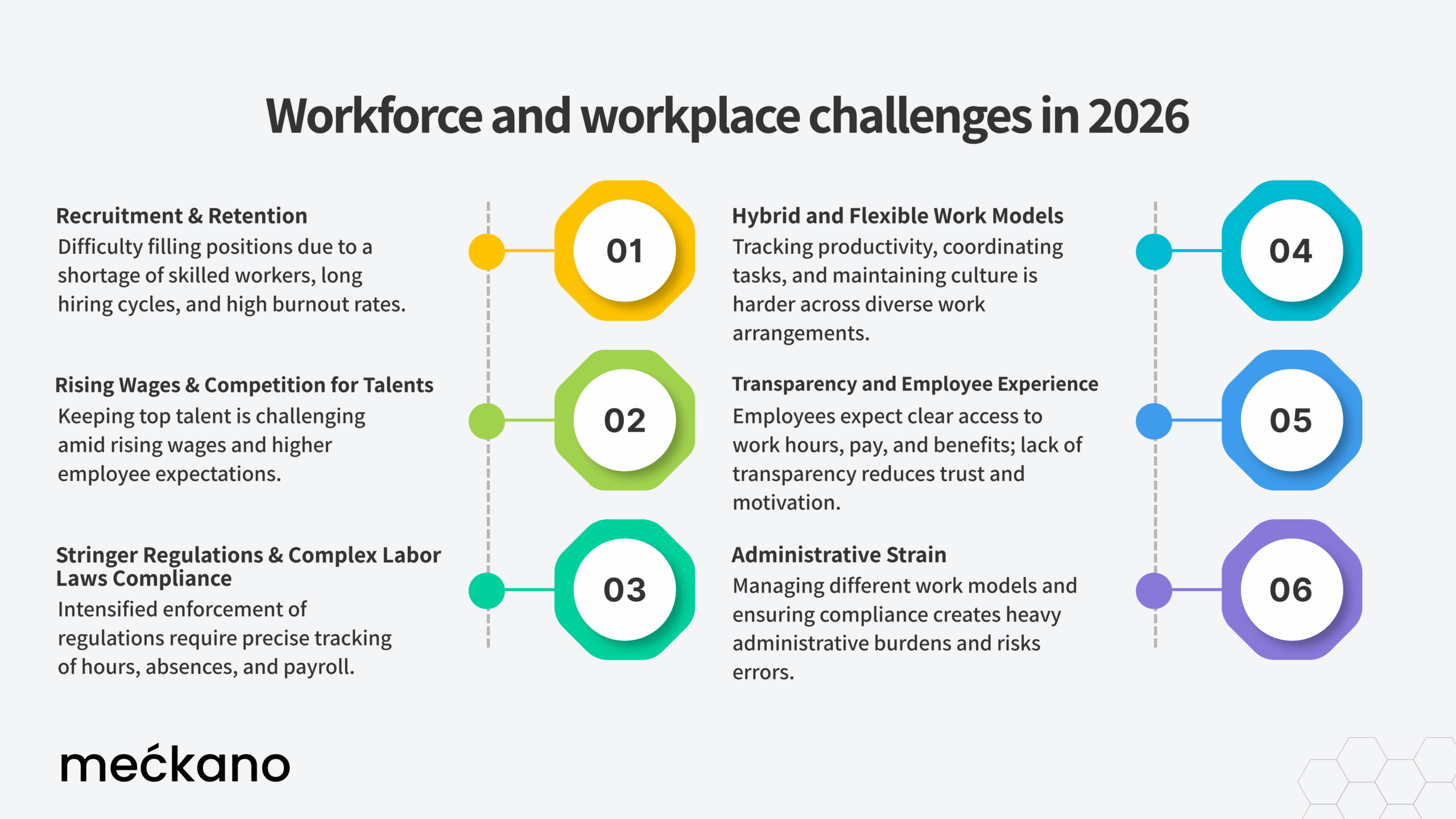

Challenge 1: Recruitment and retention

  • According to research by the Ministry of Labor and the Manufacturers’ Association, the shortage of skilled workers is expected to remain a significant growth constraint in 2026. Organizations are reporting challenges in filling positions – including prolonged recruitment cycles, and high levels of employee burnout.

    These challenges stem from a shortage of qualified personnel, high resignation rates, changing employee expectations, outdated or complicated recruitment processes, as well as external influences and a competitive market.

    The operational implication:

  • Increased workload and stress on existing staff

  • Challenges in creating balanced and effective shift schedules

  • Reduced productivity and heightened risk of burnout

Challenge 2: Rising wages and competition for talents

  • Recent reports indicate an increase in average wages, driven in part by the shortage of skilled workers. At the same time, employees demand full transparency in how their pay is calculated – including overtime and vacation – to avoid legal issues, as well as expect flexible (hybrid) work models as the standard.

    Employers who fail to meet these three expectations – competitive pay, flexibility, and accuracy – face several risks:

  • Talent competition: A lack of flexibility drives top performers to competitors.

  • Financial stability: As average wages rise, every unmanaged  or incorrectly recorded day off translates into significant additional costs.

  • Legal risk: Any payroll errors can easily lead to lawsuits.

Challenge 3: Stringer regulations and complex labor laws compliance

  • Labor authorities worldwide are intensifying enforcement of core employment statutes:

  • Working time & rest regulations: Strict requirements for tracking attendance, overtime, breaks, and absences.

  • Wage protection: Demand for absolute precision in payroll calculations, timely payments, and granular reporting of benefits (such as accrued leave and sick pay).

  • Compliance Standards: Adherence to complex contractual terms now requires organizations to implement automated attendance systems.

  • In today’s tightening regulatory environment, manual processes are a liability. Compliance now requires automated systems that enforce complex labor rules in real time. Digitally verified, error-free records are no longer optional – they are essential to avoid fines and legal risk.

Challenge 4: Managing hybrid and flexible work models

  • Despite the “return-to-office” trend, hybrid work models remain a dominant fixture of 2026. Challenges for hybrid & flexible work models include:

  • Tracking attendance & productivity: Accurately monitoring active work hours and maintaining performance visibility across decentralized teams.

  • Coordinating tasks

  • Preserving organizational culture

  • Moreover, the diversity of work models, whether office, hybrid, field, or mixed, demands tailored management strategies. Ensuring consistent working hours and task alignment across these models significantly increases managerial complexity and difficulty.

Challenge 5: Demand for transparency and enhanced employee experience

  • Employees expect greater transparency and control over their work and payroll data, including:

  • Tracking work hours and accessing attendance reports

  • Understanding the calculation of wages, overtime, benefits, and deductions

  • Identifying irregularities (missing hours or excessive overtime, for example)

  • When employee expectations outpace actual transparency – due to delayed, incomplete, or unclear information – it can lead to decreased motivation and satisfaction, reduced trust in management, and more frequent complaints or conflicts.

Challenge 6: The administrative strain on HR and management

  • A direct consequence of the three trends discussed – hybrid work models, increased regulation, and the demand for accuracy and transparency – is that managers must handle different attendance rules for each employee. For example, Employee X works in the office two days a week, Employee Y works remotely, and each has distinct rules regarding breaks and core hours. Manually tracking these rules becomes an almost impossible task. Moreover, managing and preparing this data for payroll adds complexity and can result in delays or errors. The entire administrative burden falls on managers, who must ensure reporting, enforce different work agreements, correct mistakes, and fill gaps, instead of focusing on core management responsibilities.

Turning challenges into opportunities

  • These six challenges are interconnected – each one can impact the others. Therefore, a unified infrastructure that integrates administrative, financial, and human resource management is essential. A time tracking & attendance management system provides the most straightforward and reliable solution.

    But what does such a system look like in practice?

  • Accurate tracking of work hours: The system accurately tracks all work hours in full compliance with labor laws – including regular hours, overtime, breaks, vacations, and absences – and retaining the reports for seven years. Data is up-to-date and easily accessible to both managers and employees, providing a clear, real-time overview of organizational activity. This guarantees regulatory compliance, minimizes disputes, and delivers full control over day-to-day operations.

  • Tailored policies for every work model: To streamline the management of hybrid teams, field staff, and office employees, the system allows full customization of attendance policies and work agreements according to employee type and team structure. Each employee receives the policies relevant to their role, while managers can oversee all teams consistently, without extra effort or risk of errors.

  • Automating administrative processes: The system offers automations that significantly reduce the need for manual intervention in repetitive tasks, such as absence approvals, deviation detection, smart notifications, and report generation. Rather than chasing data or approving every request manually, managers and HR teams can focus on strategic management instead of time-consuming administrative work.


  • Full transparency: The system provides employees with clear, comprehensive access to information on working hours, absences, payroll, and approval statuses. When employees know exactly what has been reported, what has been approved, and any potential deviations, it builds trust, enhances motivation, and reduces disputes, complaints, and unnecessary conflicts.

  • One-stop shop: The system functions as a centralized hub for managing every component of the workday – time and attendance tracking, HR management, tasks and projects, expense reimbursements, and payroll exports. There is no need to transfer data between multiple systems or consolidate files manually. Everything is managed in one place, structured, accurate, and free of errors.

  • While 2026 brings increasingly complex challenges, the right system can turn them into real opportunities.
    Meckano brings all organizational needs together under one unified platform – from accurate time tracking and support for any work model, to automation and full transparency – enabling managers to focus on what truly matters: performance, innovation, and sustainable growth.

    Looking to start 2026 with a efficient operating model?
    Try Meckano for free.

Popular posts

Employee Management

Employee Retention: 5 Key Practices for a Stronger Team

442 Liked
Ray Fitusi
2 minutes read
442 Liked
Read More
חזרה למשרד RTO חזרה למשרד RTO
HR Management

Beyond attendance: the RTO trust challenge

263 Liked
Ray Fitusi
3.5 minutes read
263 Liked
Read More
ניהול נוכחות עם בינה מלאכותית ניהול נוכחות עם בינה מלאכותית
Business Management

AI-driven attendance management: efficiency without complexity

168 Liked
Ray Fitusi
3 minutes read
168 Liked
Read More